Understanding Rotary Position Embeddings (RoPE): A Geometric Intuition
In modern Transformer architectures, capturing the sequential order of tokens is crucial. Since the self-attention mechanism is inherently permutation-invariant, several positioning strategies have been proposed-ranging from absolute positional encodings to various relative positional encoding schemes.
Among these, Rotary Position Embedding (RoPE) stands out for its elegant mathematical formulation and widespread adoption in state-of-the-art Large Language Models (such as LLaMA, Mistral, and Gemma).
This article provides an intuitive, step-by-step breakdown of how RoPE works, why it leverages 2D polar geometry, and how it scales to higher-dimensional embedding spaces.
1. The Core Objective: Relative Distance via Inner Products
When we compute attention scores between a query vector \(q_m\) (at position \(m\)) and a key vector \(k_n\) (at position \(n\)), we want the resulting attention score to implicitly capture their relative distance \((m - n)\) rather than their absolute positions:
Here, \(f_q\) and \(f_k\) are functions that inject positional information into the word representations \(x_m\) and \(x_n\). We want their inner product (dot product) to be a function \(g\) that depends solely on the token representations and the shift \((m - n)\).
2. The 2D Geometric Formulation (Polar Coordinates)
To understand how a dot product can naturally capture a relative offset, we can look at 2D vector spaces and represent our vectors in polar form.
Consider a 2D vector \(z = (x_1, x_2)\). In polar coordinates, it is defined by:
- Magnitude (Abstand / Distance): \(r = \|z\| = \sqrt{x_1^2 + x_2^2}\)
- Angle (\(\theta\)): \(\theta = \text{arctan}\left(\frac{x_2}{x_1}\right)\)
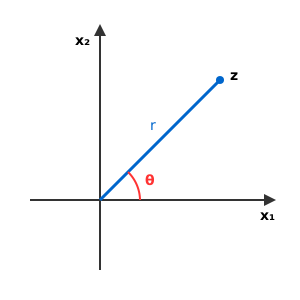
Using Euler's formula, any 2D vector can be written in the complex plane as:
Where the reverse transformation back to Cartesian coordinates is given by:
Injecting Position as a Rotation
If we encode the absolute position \(m\) as a linear addition to the angle component, our positional function looks like a rotation in the complex plane:
When we take the dot product (or the complex inner product) of the query at position \(m\) and the key at position \(n\):
Notice how the absolute positions \(m\) and \(n\) cancel out, and the resulting score depends purely on the rotation offset \((m - n)\theta\). By rotating vectors in a 2D polar space, the dot product naturally extracts relative distance!
3. Implementation in Matrix Form
In practice, neural networks operate on real-valued Cartesian vectors rather than complex numbers. We can express this 2D complex rotation as a standard 2D Rotation Matrix \(R_{\Theta, m}\):
Multiplying a 2D vector by this matrix rotates it by an angle proportional to its position \(m\).
4. Scaling to High-Dimensional Spaces (\(D > 2\))
Our hidden embedding dimensions \(D\) are typically much larger than 2. How do we scale this 2D mechanism?
The solution is highly practical: divide the \(D\)-dimensional vector into \(D/2\) independent pairs of 2D vectors, and apply a specific rotation frequency \(\theta_i\) to each pair.
Choosing the Frequencies
Following standard conventions, the frequencies are pre-computed as a geometric progression:
This ensures that different structural dimensions capture relative distances across varying wavelengths (or context granularities).
5. Why Not 3D or Higher-Dimensional Rotations?
One might wonder: if a 2D rotation works perfectly, why not use a 3D rotation matrix to group dimensions into triplets?
There are two primary mathematical reasons why 3D rotations fail to deliver the same properties:
-
Complexity of the Inner Product: In 3D space, the dot product does not simplify down to a straightforward subtraction of angles \((m - n)\). The geometry couples the absolute angular positions together, meaning absolute positions would not cleanly cancel out.
-
Non-Commutativity (Non-Abelian Group): 2D rotations commute (the order of rotation doesn't matter). However, 3D rotations are non-commutative. For example, rotating \(90^\circ\) along the X-axis and then \(45^\circ\) along the Y-axis results in a completely different orientation than rotating \(45^\circ\) along the Y-axis first and then \(90^\circ\) along the X-axis. This non-commutative property breaks the translation invariance required to learn uniform relative distances.
6. PyTorch Style Implementation Snippet
In practice, applying a full block-diagonal matrix multiplication can be computationally slow. We can optimize it by utilizing the fact that:
Here is a clean snippet showing how RoPE is typically implemented in modern LLM repositories:
import torch

def rotate_half(x):
    # Split the last dimension into two halves and swap them with a sign flip
    x1 = x[..., :x.shape[-1] // 2]
    x2 = x[..., x.shape[-1] // 2:]
    return torch.cat((-x2, x1), dim=-1)

def apply_rope(q, k, cos, sin):
    # q, k shape: [batch_size, num_heads, seq_len, head_dim]
    # cos, sin shape: [1, 1, seq_len, head_dim]

    # Standard rotary formula: R(theta, m) * x = x * cos + rotate_half(x) * sin
    q_embed = (q * cos) + (rotate_half(q) * sin)
    k_embed = (k * cos) + (rotate_half(k) * sin)

return q_embed, k_embedSummary
RoPE is an elegant synthesis of absolute and relative positional encodings. By mapping vector pairs into the complex plane and applying position-dependent rotations, it ensures that the self-attention mechanism naturally registers the physical distance between tokens. This solid mathematical foundation explains why it serves as the backbone for context window scaling techniques in modern generative AI architectures.